February 23, 2026

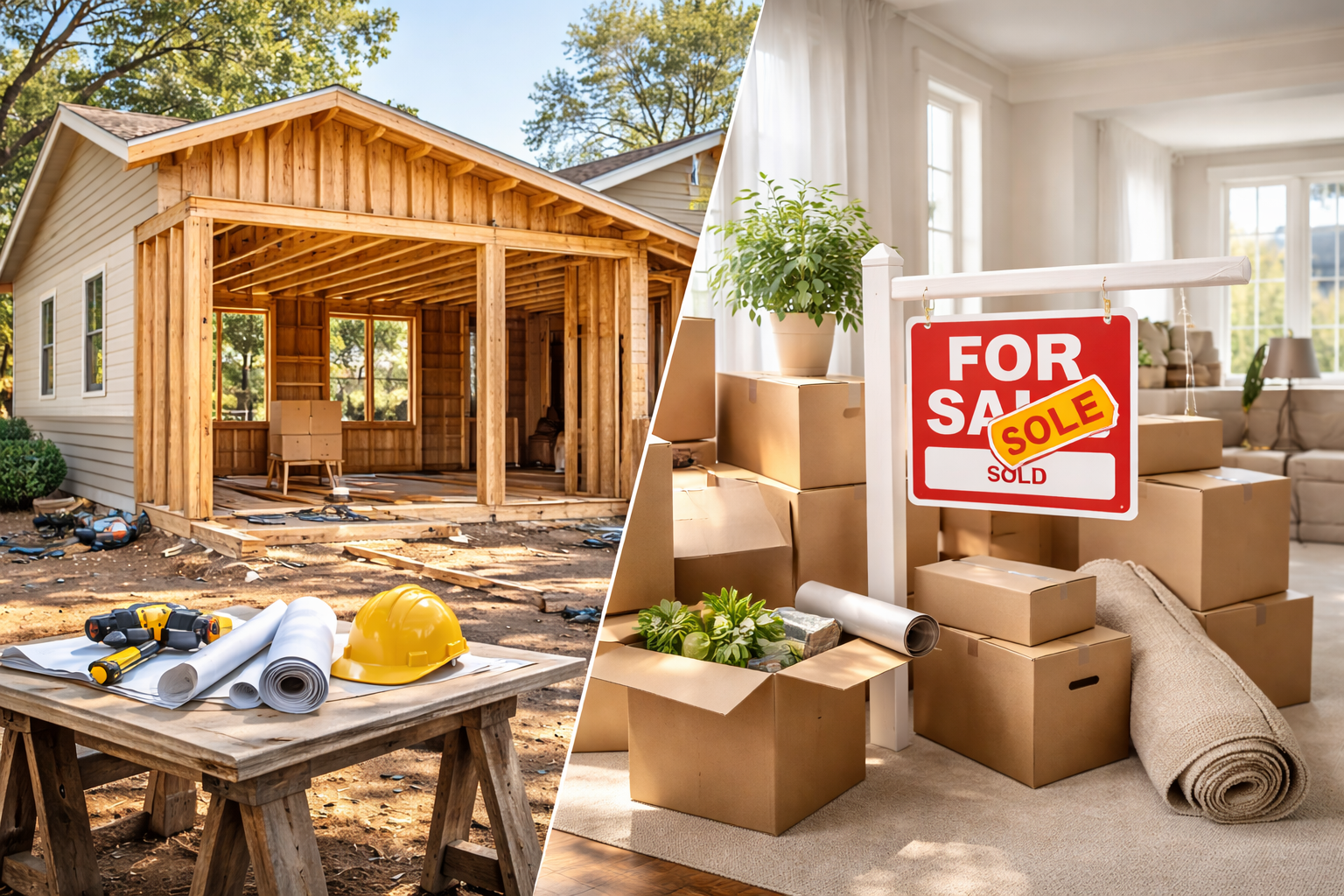
The current real estate market feels unpredictable. Interest rates are higher. Home prices are elevated. Inventory is tight. And many homeowners feel stuck in houses that no longer quite fit their lives.
If your home feels too small, your first instinct might be to call a Realtor.
But before you list your property, it’s worth slowing down and doing the math. Because in many cases, adding onto your current home makes far more financial sense than selling and buying in the same market.
Let’s talk about why.
Moving sounds simple in theory. You sell your current home and buy a larger one. Problem solved.
In reality, it’s rarely that straightforward.
When you sell a home, you’re typically paying agent commissions, closing costs, and repair negotiations before you even pack a box. Add moving expenses, new loan fees, and potential staging costs, and you can easily lose close to ten percent of your home’s value just by changing addresses.
That’s not small money.
If your home is worth $500,000, that could mean $40,000–$50,000 gone in transaction costs alone. And that doesn’t account for what happens if you’re giving up a low interest rate.
Many homeowners refinanced when rates were historically low. Moving today often means replacing that loan with a higher rate, which can significantly increase your monthly payment — even if the new home isn’t dramatically larger.
When you really step back and look at the numbers, moving can be one of the most expensive ways to gain extra space.
Instead of paying commissions and closing costs, what if you invested that money directly into your current home?
That’s what a home addition allows you to do.
Rather than starting over in a new neighborhood, adjusting to new routines, and navigating a competitive housing market, you can expand the home you already own and love.
If you love your street, your school district, your commute, and your neighbors, the problem probably isn’t location. It’s layout.
An addition gives you the opportunity to redesign your home around your current life instead of trying to squeeze your life into a new house that was designed for someone else.
From a real estate perspective, square footage is one of the strongest drivers of long-term property value.
Cosmetic upgrades can make a home look better, but adding usable space often increases both functionality and resale potential. Whether it’s a new master suite, a second story, a finished basement, or a guest wing, additional square footage can dramatically change how a home lives.
More space means flexibility. It means room for a home office, a growing family, multi-generational living, or even rental potential in certain cases.
And when additions are thoughtfully designed to match neighborhood standards and market demand, they often strengthen your home’s position in the long term.
The key is building strategically — not just bigger, but smarter.
When you buy a new home, you compromise.
Maybe the kitchen is larger, but the yard is smaller. Maybe the layout works, but the finishes don’t. Maybe the neighborhood is convenient, but the house still needs updates.
With an addition, you control the design.
You decide where the new space goes. You determine how it connects to the existing layout. You choose the materials, the finishes, and the flow.
Instead of adjusting to someone else’s vision, you build around your own.
That level of customization creates something far more valuable than extra square footage — it creates alignment with your lifestyle.
One of the biggest advantages of staying put is preserving your existing mortgage.
In today’s market, that alone can be a powerful financial reason not to move. If you locked in a low rate years ago, replacing it with today’s rates could significantly increase your long-term costs.
Financing a home addition often allows you to improve your living situation without sacrificing favorable loan terms.
Rather than resetting your entire financial structure, you’re building equity into an asset you already own.
That’s a very different kind of move.
Moving isn’t just financial. It’s emotional.
There’s comfort in familiarity. In knowing your neighbors. In having routines that work. In being close to the schools and shops you trust.
For many families, the hesitation isn’t about the house itself — it’s about leaving everything else.
An addition lets you solve the space problem without disrupting the life you’ve built.
It allows your home to evolve as your needs change.
As a company that understands both construction and real estate investment, we always encourage homeowners to think long-term.
The question isn’t just, “Will this give us more room?”
The better question is, “Will this improve our position five or ten years from now?”
When done thoughtfully, an addition can strengthen your property’s overall value, improve livability, and reduce the financial shock of moving in a volatile market.
That doesn’t mean moving is never the right decision. In some cases, location changes or zoning restrictions make relocation necessary.
But many homeowners jump to selling without evaluating what expansion could achieve.
Sometimes the smarter investment is right in your backyard.
Before you scroll through listings, take a look around your property.
Is there room to build out?
Can you build up?
Is there underused space that could be transformed?
That spare yard area might support a new wing. That roofline might allow a second story. That unfinished basement might become a private suite or flexible living area.
The house that feels too small today might already hold the foundation for your dream home.
You just need the right plan.
The real estate market may feel unpredictable, but your decisions don’t have to be rushed.
If you love where you live but need more space, an addition often provides a stronger long-term solution than moving.
It allows you to customize your home, preserve your financial position, and invest directly into your largest asset.
Sometimes the smartest move isn’t packing boxes.
Sometimes it’s building.